
News feed
BME Hosts EUCEET 2025 Conference on Teaching Gen Z Civil Engineers
2025. 11. 04.
Leading educators, researchers, and professionals gathered to exchange ideas about how universities can respond to shifting generational characteristics, digital learning environments, and evolving professional expectations.
The Budapest EUCEET 2025 Conference, hosted at BME on 16–17 October, welcomed more than 60 participants: leading educators, researchers, professionals, PhD and MSc students to exchange ideas about the future of civil engineering education and to discuss
how universities can respond to shifting generational characteristics, digital learning environments, and evolving professional expectations.
In their opening remarks, Tamás Lovas (EUCEET Vice-President) and Šarūnas Skuodis (EUCEET President) underlined the shared commitment to renewing civil engineering education through collaboration, innovation, and empathy.
The European Civil Engineering Education and Training Association (EUCEET) also announced the 2025 EUCEET Award for Excellence in Teaching in Civil Engineering, which was presented to Professor Alfonso Rodríguez Dono from the Department of Civil and Environmental Engineering at Universitat Politècnica de Catalunya (BarcelonaTech) for his exceptional contributions to innovative, impactful, and transferable teaching practices.
Intergenerational expert Enikő Bereczki-Fodor opened the conference’s keynote program with an engaging reflection on the learning habits and attitudes of Generation Z. Her message was clear: educators must listen to the next generation and build trust through meaningful communication and student-centered teaching strategies.

Alan Kwan, deputy head of school at Cardiff University, addressed how universities can adapt to both Gen Z and Gen Alpha. He argued that the future of engineering education lies in creating immersive, adaptive, and collaborative learning environments.
Šarūnas Skuodis shared insights from Vilnius Tech’s Faculty of Civil Engineering, where targeted academic support and policy adjustments have improved student motivation and reduced dropout rates. He emphasized the role of gamification, fieldwork, and mental health support in student success.
Ross Higgins & Michael Quilligan of the University of Limerick presented findings from a mixed-methods highlighting that
the shortcomings of AI handling complex structural analysis problems offer learning opportunities, encouraging critical evaluation and responsible AI use.
Declan Phillips of the University of Limerick revisited traditional oral examination methods, showing how structured interviews can serve as authentic assessments in modern engineering education.
BME’s Balázs Nagy discussed how transversal competences—communication, leadership, and creativity—are integrated into BME’s Construction Information Technology Engineering MSc programme. Students participate in sensor-based monitoring projects and international EELISA hackathons, applying teamwork and project management skills to real engineering problems.
Professor Sofie Craps of KU Leuven explored how engineering identity develops through education and how universities can nurture it intentionally. She also stressed the need for inclusive, diverse educational cultures that help students see themselves as capable, confident engineers.
Kitti Ajtayné Károlyfi presented Széchenyi University’s approach to integrating Building Information Modeling (BIM) and project-based learning into both architecture and civil engineering programs, while Rita Sassine reflected on the shift from short, limited problem-based projects to larger, more sustained initiatives at ESTP Paris.
José Antonio Lozano Galant of the University of Castilla-La Mancha discussed Spain’s national wooden bridge competition which encourages teamwork, creativity, and a tangible understanding of structural mechanics while reinforcing motivation and practical competence.
Acacia Naves of the University of La Coruña illustrated ongoing efforts in Spain to balance academic rigor with flexibility and digitalization while addressing national and European qualification standards.
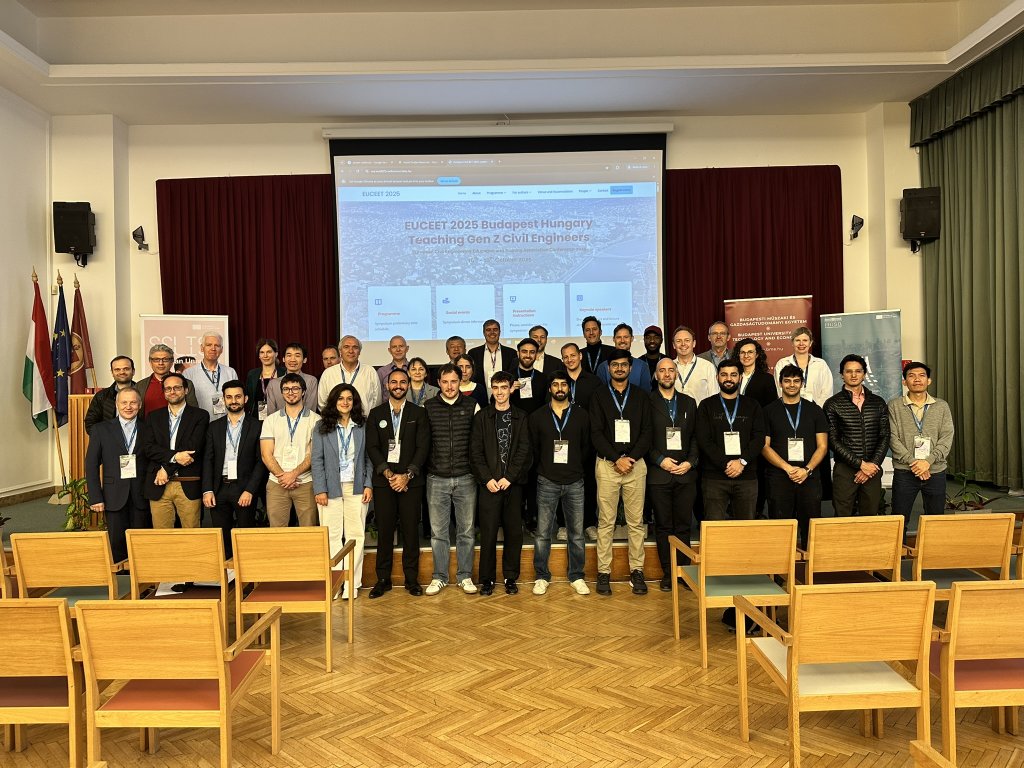
On the second day of the conference, keynote speaker Emanuela Tilley, president of SEFI, argued that civil engineering must become more attractive through authentic, challenge-based learning that connects directly to societal needs.
Giulia Sonetti of the Polytechnic University of Catalonia reminded participants in her keynote address that while the challenges ahead are immense, by sharing our struggles and supporting one another, we can transform anxiety into collective strength and move forward with hope and purpose.
Seyedmilad Komarizadehasl of the Polytechnic University of Catalonia presented a studio model where students measure eigenfrequencies and damping with the sensors in their own phones, select their own approach, then validate against commercial datasets.
Šarūnas Skuodis stressed the importance of vision for Gen Z learners: virtual labs cultivate early engagement, followed by physical lab immersion to consolidate skills.
Chafic Achour of ESTP Orléans presented a project that connected digital surveying with conservation goals, showing students how advanced capture, rendering, and documentation can steer real restoration decisions.
Fidel Lozano of the University of Castilla-La Mancha demonstrated a Dynamo workflow that models beam behavior directly inside a BIM context. The value for learners came from seeing cause and effect immediately inside the design environment.
In his presentation, Primož Jelušič of the Univeristy of Maribor outlined a tiered framework for teaching optimization from undergraduate to PhD levels.
Paulo Cachim of the University of Aveiro described a semester project where student teams design board games that teach sustainable construction to high-school learners.
The approach builds analytical thinking, communication, teamwork, and creativity while spreading sustainability literacy beyond the university.
In his second talk of the conference, Mr Komarizadehasl introduced the one-year NoRisk program: an intensive coursework phase plus dissertation, rotating across partner universities with an integration week at the start.
Katerina Kovarova of the Czech Technical University addressed the common challenge of low student engagement in geology by introducing “geological gastronomy.” By making geology accessible and memorable, Kovarova’s approach helps future engineers see the relevance of geological understanding in areas such as foundations, tunneling, and hazard assessment.
The conference ended with a visit to the József Gruber Reservoir.

Rector’s Office, Communications Directorate